
Mastering Dessert Service: A Step-by-Step SOP for Consistent Quality and Increased Sales
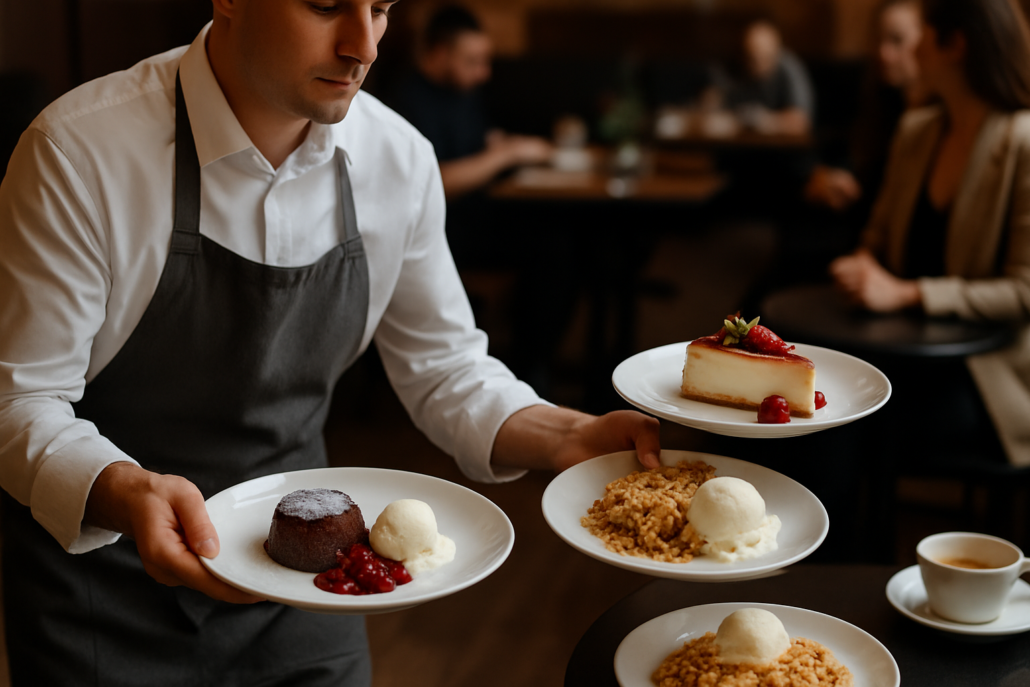
Mastering Dessert Service: A Step-by-Step SOP for Consistent Quality and Increased Sales
Desserts are one of the highest-margin items in your restaurant or café, but during peak service they’re also the first thing to get rushed, skipped, or served in poor condition. Melted ice cream, collapsed whipped cream, lukewarm sauces, and missed upsell opportunities all come from the same root problem: no standardized front-of-house choreography.
This playbook gives FOH managers and trainers a complete dessert service SOP: precise sequences, timing benchmarks, and micro-scripts you can plug into pre-shift, train quickly, and audit easily—so you preserve texture and temperature and increase dessert attachment and check average.
1. Define Your Dessert Service Objectives
Before you build scripts and choreography, set clear service standards your team can understand and hit during peak periods.
1.1 Quality standards (texture + temperature)
- Cold desserts (ice cream, sorbet, chilled mousse, cheesecake):
- Serve within 60–90 seconds of leaving the pass.
- Ice cream should hold its shape for at least 5 minutes at the table (no pooling on arrival).
- Plates for ice cream-based desserts are pre-chilled (fridge or lowboy) during peak.
- Hot desserts (lava cakes, crumbles, bread puddings):
- Leave kitchen to table in under 2 minutes.
- Serve on warm plates if recipe requires.
- Ice cream/whipped cream added at the pass only when the server is physically present and ready to run.
- Ambient desserts (tarts, cakes, cookies):
- Serve within 3 minutes of ticket fire.
- Plates dry and clean, garnishes intact and not bleeding color.
1.2 Sales and attach-rate objectives
- Dessert attach rate target: set a clear benchmark (e.g., “30% of parties order at least one dessert,” or “50% of 2-tops share one dessert”).
- Add-on target: at least one paired beverage offered with every dessert pitch (coffee, tea, dessert wine, cordial, affogato, etc.).
- Time-to-offer benchmark: every table is invited to consider dessert within 2 minutes of mains being cleared or signaled as done.
Post these benchmarks where staff can see them. Use pre-shift to review yesterday’s performance and today’s target.
2. Pre-Shift Dessert Service Checklist (FOH Manager)
Use this checklist before every busy service. Adjust the details to your menu, but keep the structure.
2.1 Menu & availability check (10–15 minutes before doors)
- Verify today’s dessert menu:
- Confirm all items are in stock and 86’d items are updated on POS and server notes.
- Clarify portion sizes, shareability, and any changes to plating/garnish.
- Review prep limits for baked-to-order items (e.g., max per 15 minutes).
- Confirm pairing recommendations:
- 1–2 ideal beverages for each dessert (e.g., “chocolate lava cake → espresso / port”, “lemon tart → herbal tea / prosecco”).
- Note suggested phrases (see scripts below).
2.2 Tools, station setup, and temperature control
- Plates and glassware:
- Cold desserts: ensure a stack of chilled plates is ready at dessert station.
- Hot desserts: have warm plates available if recipes call for it.
- Espresso/coffee cups staged at bar or service station.
- Garnish and finishing:
- Check whipped cream, sauces, berries, mint, powders, nuts.
- Confirm holding conditions (cold line vs ambient) to avoid wilted/flat garnishes.
- Runner path:
- Walk the route from pass to longest-distance table.
- Remove any obstacles that add seconds to delivery for temperature-sensitive desserts.
2.3 Pre-shift alignment and micro-training (5–7 minutes)
In pre-shift, quickly align the team on today’s dessert choreography.
- Announce the focus: “Tonight’s focus is dessert timing and attach rate. Target: 1 in 3 tables orders dessert.”
- Review top 3 desserts: for each, share:
- One texture/temperature point (e.g., “served warm with cold ice cream”).
- One short script line they can use at the table.
- Demo the sequence (manager + 1 server):
- Simulate clearing mains → dessert pitch → order to kitchen → running desserts.
- Time it with a phone to reinforce benchmarks.
- Assign roles for peak:
- Designate a “dessert captain” for the shift (strongest server or closer) who:
- Helps others with dessert pitches.
- Monitors timing for baked-to-order items.
- Coordinates with expo on when to add ice cream and cream.
- Designate a “dessert captain” for the shift (strongest server or closer) who:
3. Service Choreography: Dessert Flow from Signal to Payment
This is the core SOP: a standardized sequence your team follows every time. Timeframes are for a single-location casual or upscale-casual restaurant or café; adjust as needed.
Step 1: Detect the “dessert decision” moment (0–2 minutes)
Servers and support should be trained to recognize when a table is ready to consider dessert:
- Plates are 70–80% finished, guests slowing down.
- Guests push plates away or place cutlery together.
- Conversation shifts and guests start looking around for staff.
Timing benchmark: approach within 2 minutes of these signals.
Sample script (before clearing plates):
“How was everything for you? I’ll clear these in just a moment. Before I do, we have a few desserts that are perfect for sharing—would you like to take a quick look at the dessert options while I clear the table?”
This keeps the dessert pitch from being an afterthought and frames dessert as the default next step.
Step 2: Clear & reset with a dessert intention (2–4 minutes)
While clearing, you’re setting the stage and planting a specific dessert in their mind.
- Clear main plates and unnecessary cutlery first.
- Leave water, drinks, and one clean share plate if dessert is likely.
- Keep the table from feeling “closed” (no dropping check yet).
Sample script while clearing:
“We have a warm [lava cake / crumble] that comes out with a scoop of [house ice cream] that’s perfect for two or three people to share. We also have a lighter option, our [lemon tart / sorbet trio] if you prefer something refreshing.”
Always offer one indulgent and one lighter option to reduce decision friction.
Step 3: Present dessert options with micro-scripts (4–7 minutes)
Servers don’t need to recite the whole dessert menu. They need two to three curated recommendations plus a clear close.
Sample structured script:
“We keep our dessert list short and focused. The top three that people love are:
- Our warm chocolate cake—baked to order, with a molten center and vanilla bean ice cream.”
- “The seasonal fruit crumble—served hot with a crisp topping and a scoop of [flavor] ice cream.”
- “And a lighter option—the [citrus tart / sorbet trio], really bright and refreshing.”
“Do you feel more like something rich and chocolatey or something lighter to share?”
This script does three things:
- Highlights temperature/texture (“warm,” “molten,” “crisp,” “refreshing”).
- Frames desserts as shareable, increasing order likelihood for price-sensitive guests.
- Ends with an either/or choice, not a yes/no question.
Step 4: Lock dessert + beverage pairings (7–9 minutes)
Once they commit to dessert, immediately attach a drink suggestion before leaving the table.
Sample pairing script:
- “That warm chocolate cake is great with a small espresso or a glass of [dessert wine / port]. Would you like something like that to go with it?”
- “The lemon tart is really nice with an herbal tea or a cappuccino. Can I bring you a coffee or tea to arrive just before dessert?”
Timing benchmark: the dessert order (with beverage pairings) should be sent to the kitchen within 2 minutes of the guest choosing.
Step 5: Communicate with kitchen and expo (9–10 minutes)
The handoff between FOH and BOH is where texture and temperature are most at risk. Use clear, consistent language and tickets.
- Mark tickets with:
- “FIRE NOW” for quick desserts.
- “FIRE IN 5” when guests are still lingering; server must set a mental timer.
- “ICE CREAM ON RUNNER” or “ICE CREAM LAST SECOND” when the server will be present at the pass to minimize melt.
- Expo calls:
- “Need server at pass for ice cream on Table 12 lava cake” instead of plating and letting it sit.
Manager’s role: spot-check tickets during peak to ensure dessert tickets aren’t sitting without runner assignment.
Step 6: Run desserts with quality checks (10–15 minutes)
Timing benchmarks from pass to table:
- Cold desserts: 60–90 seconds.
- Hot desserts with ice cream: under 2 minutes from adding ice cream to table drop.
- Ambient desserts: under 3 minutes but prioritize those with whipped cream or sauce that can bleed.
Runner/server micro-checks at pass:
- Is ice cream visibly sliding or already pooling? If yes, send back for re-plate.
- Is plate hot enough / cold enough according to standard?
- Is the garnish upright, not wilted, smudged, or melted?
Drop script at table:
- “Here’s your warm chocolate cake, just out of the oven, with the ice cream starting to melt into the center.”
- “And the lemon tart—nice and cool with a crisp crust. Can I bring anything else to go with these?”
Name the texture and temperature as you set it down—this primes guests to notice and appreciate quality.
Step 7: Check-back and bill timing (15–25 minutes)
The final stage balances guest experience with table turn and one last upsell opportunity.
- Check-back timing: return 3–4 minutes after dessert drop.
- “How’s the dessert? Is the center of the cake warm enough for you?”
- Subtle final upsell: small add-ons (digestif, extra coffee) can still be attached if appropriate.
- “If you’d like to linger, I can bring a small [cordial / dessert wine] to finish. Otherwise, I can get your check ready whenever you’re ready.”
- Check delivery: place the check only after dessert is half-finished or when they signal they’re done.
- Avoid dropping the check with dessert—it psychologically closes the experience and kills add-ons.
4. Micro-Scripts for Common Dessert Service Scenarios
Training servers with short, repeatable micro-scripts reduces hesitation and keeps pitches consistent during busy periods.
4.1 When the guest “never” does dessert
Guest: “We never really do dessert.”
Server script:
“No problem at all. If you’d like just a bite of something sweet, our [mini dessert / single cookie / small pot de crème] is perfect for sharing and won’t feel heavy. Would you like to split one between you?”
This reframes dessert as a small add-on, not a full commitment.
4.2 When the table is in a rush
Guest: “We’re kind of in a hurry.”
Server script:
“Totally understand. We have one or two desserts that are quick to plate—our [cheesecake / tart / scoop trio] can be out in about five minutes. Or if you prefer, I can bring a couple of cookies with the check so you have something sweet to go.”
Offer only fast-fire options and communicate clear timing.
4.3 When they’re undecided between two desserts
Guest: “We can’t decide between the chocolate cake and the fruit crumble.”
Server script:
“If you like rich, go with the chocolate cake—it’s warm and gooey. If you want something a bit lighter, the crumble is sweet but not heavy. Since there are [number] of you, I’d actually suggest getting both to share, so everyone gets a bite of each.”
Here, you both guide the decision and suggest sharing to boost check average.
4.4 When a dessert takes longer (baked to order)
Server script when ordering:
“Just a heads up: the chocolate cake is baked to order, so it takes about 12 minutes, but it comes out piping hot with ice cream. If you’re happy to linger a bit, it’s worth the wait.”
Update script if delayed:
“Thank you for your patience—they’re baking your cake to order. It should be out in just a couple more minutes. Can I refresh your water or coffee while you wait?”
Setting expectations protects perceived quality even under delay.
5. Timing Benchmarks by Dessert Type
Standardize expectations by dessert category so servers, expo, and BOH are aligned.
5.1 Ice cream & frozen desserts
- From scoop to table: 60–90 seconds max.
- FOH rule: never let a frozen dessert sit in the window; runner must be assigned before it is finished at the pass.
- Pre-shift note: during peak, expo calls, “Ice cream ready Table X—runner ready?” before placing final scoop.
5.2 Hot + cold combo desserts
- From adding cold element to table: under 2 minutes.
- Sequence:
- Hot component plated and garnished.
- Server/runner physically present.
- Ice cream/cream added last second.
- Manager audit: spot-check for melted ice cream at the table during peak and coach on timing.
5.3 Room-temperature desserts
- From ticket to table: 3 minutes target during peak; no more than 5 minutes.
- FOH tactic: use these to satisfy guests in a hurry.
- Training point: even ambient desserts suffer if they sit—garnishes wilt, sauces form skin, crusts lose snap.
6. Standardized Dessert Service SOP (Quick Reference)
Use this as your printed SOP card or training sheet.
- Spot the dessert moment (0–2 minutes)
- Guests slowing down / plates mostly finished.
- Approach within 2 minutes, before full clear.
- Plant the idea while clearing (2–4 minutes)
- Clear plates, leave space open for “next step.”
- Offer one indulgent + one lighter option.
- Curate 2–3 dessert options (4–7 minutes)
- Describe temperature and texture briefly.
- Use an either/or closing question.
- Attach beverages (7–9 minutes)
- Suggest coffee/tea or a small dessert drink with specific pairing.
- Send dessert + beverage order to POS within 2 minutes.
- Coordinate with kitchen (9–10 minutes)
- Mark tickets clearly: FIRE NOW / FIRE IN 5 / ICE CREAM LAST SECOND.
- Expo ensures server/runner present before adding meltable items.
- Run with quality checks (10–15 minutes)
- Check for melt, plate temp, intact garnish.
- Table drop includes a brief description highlighting “warm/cold/crisp.”
- Check-back and close (15–25 minutes)
- Check back after 3–4 minutes.
- Offer final small add-on if appropriate.
- Drop check once dessert is half-finished or guests signal they’re done.
7. Training, Coaching, and Measurement
Consistent dessert service doesn’t happen from one pre-shift. Build it into your training loop.
7.1 Onboarding new servers
- Include this dessert SOP in day-one training.
- Have new hires memorize 2–3 scripts and practice them in role play.
- Shadow a “dessert captain” for one shift, focusing only on watching timing and pitches.
7.2 Live coaching during service
- Managers quietly observe:
- How long between main plates finishing and dessert pitch?
- Are servers using either/or questions?
- How long do desserts sit in the window?
- Give one focused note at cut or end-of-shift, not a laundry list.
7.3 Tracking performance
- Pull daily or weekly reports for:
- Dessert sales by server.
- Dessert attach rate (tables with at least one dessert).
- Coffee/tea/dessert drink attach rate with dessert.
- Share results in pre-shift:
- Recognize top performers (and ask them to demo scripts).
- Set a simple challenge (e.g., “If we hit 30% attach tonight, we do a staff treat next week.”).
Conclusion: Turn Dessert into a Reliable System, Not a Gamble
When dessert service is left to chance, you lose texture, temperature, and sales. By choreographing a clear FOH sequence, setting realistic timing benchmarks, and arming your team with short, natural micro-scripts, you make dessert a consistent part of your guest flow instead of an optional afterthought.
As a next step, turn this SOP into a one-page checklist and a short role-play in your next three pre-shift meetings. Time the sequence, coach the scripts, and track your dessert attach rate. Within a few services, you’ll see more consistent quality at the table and a noticeable lift in dessert and beverage sales.
