
Scalable Italian-Inspired Cake Bases: Transform Your Dessert Menu with Minimal Labor and Maximum Profit
Scalable Italian-Inspired Cake Bases: Transform Your Dessert Menu with Minimal Labor and Maximum Profit
Culinary directors and commissary bakers don’t need more cake recipes—they need systems that scale. Central production, frozen inventory, and quick finishing at the unit level only work when your bases are stable, versatile, and profitable per slice.
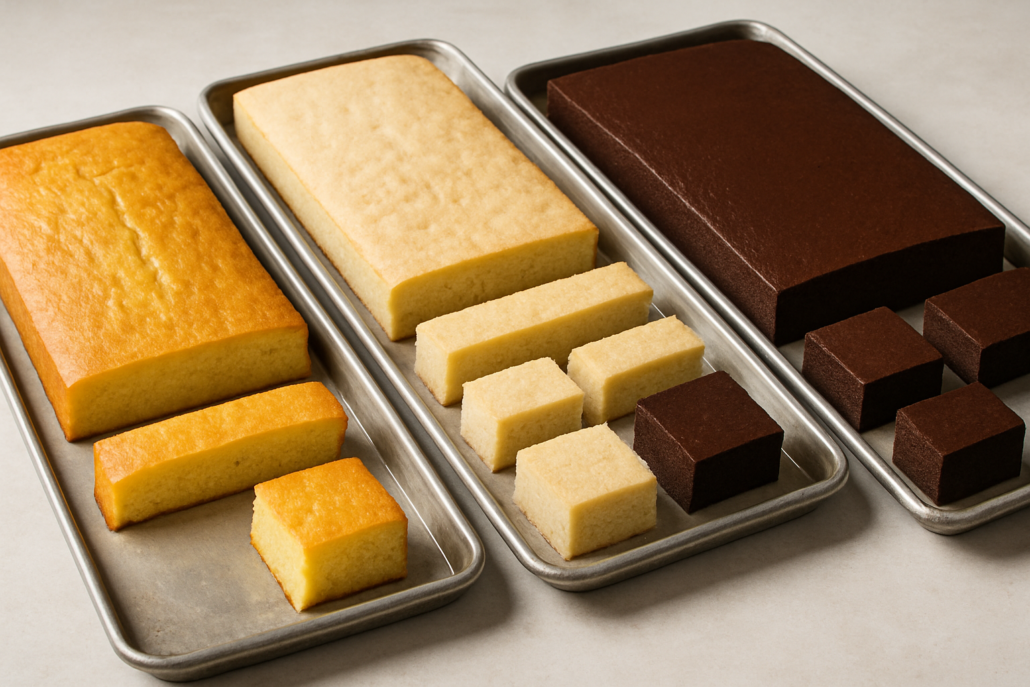
This blueprint gives you three batch-friendly, Italian-inspired cake bases that spin into nine distinct, menu-ready desserts. Each base is engineered for high-volume production, blast freezing, and transport, with guidance on yields, holding specs, and per-slice cost control.
Overview: Three Base Cakes, Nine Menu Variations
These base recipes are designed as modular “building blocks” for multi-unit programs:
- Base Cake 1 – Olive Oil Citrus Sheet Cake
- Profile: Moist, fine crumb, fragrant with citrus and extra-virgin olive oil
- Strengths: Excellent freeze/thaw, neutral enough to carry various fillings, minimal staling
- Variations: Limoncello Tres Leches, Citrus Mascarpone Torte, Almond-Orange “Torta della Nonna” Bars
- Base Cake 2 – Classic Almond Sponge (Pan di Spagna–Style)
- Profile: Light, airy, ideal for soaking and layering
- Strengths: Low fat (cost-effective), takes on syrups and liqueurs, fast to cool
- Variations: Tiramisu Slab, Cassata Sheet Roll, Espresso-Almond Trifle Cubes
- Base Cake 3 – Dark Chocolate Mascarpone Cake
- Profile: Dense, velvety crumb, rich cocoa and mascarpone
- Strengths: High moisture, strong structure for cutting and glazing, indulgent but portionable
- Variations: Chocolate-Hazelnut Gianduja Squares, “Sicilian” Chocolate Orange Cake, Black Cherry & Chocolate Bar
All three are built for:
- Sheet pans first (efficient bake, easy portioning, flexible formats)
- Blast freezing in slabs or pre-cut portions
- Finishing at unit level with sauces, syrups, and garnishes that read “Italian” but are labor-light
Standard Assumptions for Batch Sheets & Costing
To keep the blueprints practical, the following assumptions apply unless otherwise noted:
- Pan size: Full sheet, 18 x 26 in (46 x 66 cm)
- Portion sizes:
- Standard dessert plate: 3 x 3 in (approx. 12 portions per half sheet, 24 per full sheet)
- Banquet: 2.5 x 2.5 in (20 per half sheet, 40 per full sheet)
- Yields: Listed per full sheet; scale up/down for your volume
- Costing: No fake numbers; instead, you’ll see where savings typically occur and where premium ingredients pay off per slice
Base Cake 1: Olive Oil Citrus Sheet Cake
Positioning & Use Case
This is your workhorse “Mediterranean” cake: aromatic, moist, and forgiving. It can go upscale (plated dessert with mascarpone) or casual (traybake bar), and stays tender through multiple freeze/thaw cycles.
Formula: Olive Oil Citrus Sheet Cake (Full Sheet)
- Yield: 1 full sheet, approx. 24–40 portions depending on cut
- Mixing method: Liquid fat cake, all-in-two-stage
Ingredients (baker’s-style percentages relative to flour = 100%)
- 100% AP flour (low–moderate protein, 10–11.5%)
- 90–100% granulated sugar
- 4% baking powder
- 1% fine sea salt
- 50% whole eggs
- 70% whole milk (or 50% milk + 20% buttermilk for tang)
- 60% extra-virgin olive oil (blend with neutral oil up to 50/50 if needed)
- 8% citrus juice (lemon and/or orange)
- Zest of 6–8 lemons and/or oranges per full sheet
- Optional: 3% honey for flavor and moisture retention
Process Notes
- Whisk dry: flour, baking powder, salt, sugar.
- Combine wet: eggs, milk, oils, citrus juice, zest, honey.
- Mix on low until hydrated, then medium just until smooth. Avoid overmixing to limit tunneling.
- Pan: Line full sheet with parchment; deposit batter evenly (approx. 2.5–3.0 kg, depending on thickness).
- Bake: 325–335°F (165–170°C) convection, 16–22 minutes, rotating once. Target: light golden, internal 200–205°F (93–96°C).
- Cool fully on racks before wrapping or cutting.
Holding, Freezing & Transport Specs
- Chilled shelf life: 4–5 days wrapped, 0–4°C
- Frozen shelf life: 6–8 weeks, double-wrapped; minimal flavor loss
- Thawing: Slabs thaw in 2–4 hours under refrigeration; pre-cut pieces 60–90 minutes
- Transport: Leave in full sheets or cut into bars and tray-pack with parchment layers; finish with toppings at unit level
Cost Considerations
- Olive oil is the primary cost driver; a calibrated blend (e.g., 60% EVOO, 40% refined or canola) lowers cost while keeping flavor.
- Higher sugar and oil percentages translate to longer moistness, which reduces waste and shrinkage.
- Premium citrus (fresh zest vs. extract) should be reserved for top-tier locations or used selectively in finishing syrups.
Variation 1: Limoncello Tres Leches Sheet
Concept: Italian-inspired spin on tres leches; soaked sheet cake, served cold, very freezer-friendly.
- Use case: Banquets, catering drop-offs, QSR upscale “special” dessert
- Incremental labor at unit: Very low (cut, garnish, plate)
Additional Soak & Topping Per Full Sheet
- 750 g sweetened condensed milk
- 600 g evaporated milk or whole milk
- 150–250 g limoncello (adjust for concept, can swap with lemon syrup for non-alcoholic)
- 300–400 g lightly sweetened whipped cream or stabilized topping
- Lemon zest, microplane, for finish
Make-Ahead & Handling
- Bake and cool olive oil citrus sheet.
- Mix soak; apply evenly over poked cake (use skewer or fork over entire surface).
- Chill overnight to absorb. Portion after soaking or pre-cut then soak in hotel pans.
- Top with whipped cream day of service or at commissary before freezing slabs.
Yield & Costing
- Portion: 3 x 3 in (24 pieces per full sheet)
- Cost per slice is driven by dairy and limoncello. To control:
- Reduce limoncello to a surface brush and flavor whipped cream with zest and extract instead.
- Use a stable whipped topping for lower-cost banquet settings.
Variation 2: Citrus Mascarpone Layer Torte
Concept: Cut the base sheet into layers, fill with mascarpone cream, finish like a modern plated Italian torte.
- Use case: Upscale casual or fine dining units sharing a commissary
Additional Components
- Mascarpone cream: mascarpone + whipped cream + sugar + lemon zest
- Simple syrup with limoncello or orange liqueur
- Thin layer of apricot or citrus jam (optional for sheen and stability)
Assembly Blueprint
- From one full sheet, cut two or three equal rectangles (stackable layers).
- Brush each with flavored syrup.
- Pipe mascarpone cream between layers; optionally spread thin jam layer under cream.
- Chill, then trim edges and portion into 2.5 x 3 or 3 x 3 in slices.
Operational Advantage
- Commissary can assemble full torte slabs, freeze, then ship pre-cut, with units only adding plate garnishes (coulis, candied peel).
- Portion control is excellent; every slice is uniform and premium-priced.
Variation 3: Almond-Orange “Torta della Nonna” Bars
Concept: Use the citrus olive oil base as a carrier for flavors reminiscent of torta della nonna—almond, citrus, pastry cream, pine nuts—reimagined as bars.
- Use case: Coffee program, grab-and-go dessert, catering platters
Additional Components
- Thin layer of almond pastry cream or frangipane spread over the cooled base
- Toasted pine nuts or sliced almonds on top
- Light dusting of powdered sugar after baking or just before service
Method
- Spread a thin frangipane layer (approx. 5–7 mm) over par-baked olive oil citrus cake.
- Top with nuts and bake an additional 8–10 minutes until set and lightly golden.
- Cool, cut into rectangular bars (e.g., 2 x 4 in for pastry case, 3 x 3 in for plated dessert).
Holding & Profit
- Excellent 3–4 day refrigerated shelf life; can be frozen as bars.
- Higher cost from nuts is compensated by smaller portions and premium positioning (pair with espresso/affogato).
Base Cake 2: Classic Almond Sponge (Pan di Spagna–Style)
Positioning & Use Case
This is your neutral, highly adaptable sponge for soaking, layering, and rolling. It’s low in fat (inexpensive) and functions as a structural base for rich creams and liqueur syrups.
Formula: Almond Sponge Sheet (Full Sheet)
- Yield: 1 full sheet, approx. 24–40 portions or 1–2 rolled cakes
- Mixing method: Egg foam sponge
Ingredients (by weight, representative ratio)
- 1000 g whole eggs
- 600 g granulated sugar
- 600 g cake flour (or low-protein AP, sifted)
- 150 g finely ground blanched almonds or almond flour
- 5 g fine salt
- 10 g vanilla extract or paste
- Optional: 20–40 g melted butter or neutral oil for flexibility (slightly less traditional but improves freeze/thaw)
Process Notes
- Whip eggs, sugar, salt, and vanilla to full volume (ribbon stage), 8–10 minutes on stand mixer.
- Sift flour and almond flour together.
- Fold dry into foam gently in 3–4 additions. If using melted butter, temper with a small portion of batter, then fold in last.
- Spread evenly in lined, lightly greased full sheet pan; target an even, thin layer for rolls or slightly thicker for slabs.
- Bake at 350°F (175°C) convection, 10–14 minutes, just golden.
- Cool in pan or invert onto sugared parchment if rolling to prevent sticking.
Holding, Freezing & Transport Specs
- Chilled shelf life unsyruped: 2–3 days (prone to drying without soak)
- Frozen shelf life unsyruped: 4–6 weeks, tightly wrapped
- Best practice: Syrup and assemble into final format at commissary; ship frozen as finished slabs/rolls.
Variation 4: Tiramisu Slab (High-Volume Format)
Concept: Replace individual ladyfingers with almond sponge layers to build large-format tiramisu slabs that can be portioned and plated quickly.
Additional Components
- Espresso soak: strong coffee/espresso + sugar + optional Marsala/rum
- Mascarpone cream: mascarpone + sugar + egg yolks (or pasteurized yolk product) + whipped cream
- Cocoa powder and chocolate shavings for finish
Assembly Blueprint
- Split almond sponge into two or three equal layers.
- Lay one layer in a hotel pan or sheet frame; brush heavily with espresso soak.
- Spread mascarpone cream; repeat with second (and third) layer.
- Chill at least 8 hours, then freeze solid if shipping.
- Dust with cocoa after cutting at unit level to avoid condensation marks during transport.
Yield & Efficiency
- One full sheet easily yields 24–30 elegant 3 x 3 in portions.
- High margin: eggs and dairy are balanced by minimal fat in the sponge.
- Portioning at commissary (pre-cut & paper-cup each slice) simplifies assembly on-site.
Variation 5: Cassata Sheet Roll
Concept: Inspired by Sicilian cassata: sponge roll filled with ricotta cream, candied fruit, and sometimes chocolate chips; finished with thin glaze.
Additional Components
- Ricotta filling: smooth ricotta + powdered sugar + vanilla + chopped candied citrus + mini chocolate chips
- Simple syrup flavored with citrus and/or sweet wine (e.g., Marsala)
- Thin citrus glaze or fondant for exterior
Method
- While sponge is still warm, invert onto sugared parchment, peel backing paper, and roll lightly (with parchment) to set shape.
- Unroll when cool; brush with flavored syrup.
- Spread ricotta filling evenly; re-roll tightly using parchment for support.
- Wrap and chill or freeze. Glaze after thawing or at unit level.
Operational Tips
- Each full sheet can make 2–3 rolls depending on thickness; each roll yields 10–12 slices.
- Perfect for catering and buffets; pre-slice at commissary and tray-pack.
- Ricotta fillings freeze reasonably well if stabilized with 10–20% mascarpone or cream cheese.
Variation 6: Espresso-Almond Trifle Cubes
Concept: Use trim and off-cuts from sponge for a layered trifle in glassware or cups—eliminating waste and creating a high-perceived-value dessert.
Components
- Cubes of almond sponge (off-cuts or purpose-cut)
- Espresso syrup
- Almond or amaretto pastry cream or mousse
- Whipped cream and shaved chocolate
Assembly & Efficiency
- At commissary, build in clear plastic cups or glassware in hotel pans (for transport).
- Layer sponge + syrup + cream; repeat; finish with whipped cream and garnish at unit.
- Excellent for banquets where build-in-place glassware is acceptable.
Profit Lever
- Product utilizes otherwise low-value scraps.
- Mini portions command strong price in tasting menus and dessert flights.
Base Cake 3: Dark Chocolate Mascarpone Cake
Positioning & Use Case
This base delivers a luxurious Italian-leaning chocolate profile with mascarpone for tang and structure. It handles ganache, glaze, and soaking without collapsing.
Formula: Dark Chocolate Mascarpone Sheet Cake (Full Sheet)
- Yield: 1 full sheet, 24–40 portions
- Mixing method: Creaming/emulsified batter
Ingredients (percentages relative to flour = 100%)
- 100% AP flour
- 90–100% sugar
- 20% cocoa powder (Dutch-process preferred)
- 3% baking powder
- 1% baking soda
- 1% salt
- 60% whole eggs
- 40% neutral oil
- 40% mascarpone cheese
- 80% buttermilk (or 60% milk + 20% sour cream)
- 70–90% hot coffee or hot water (for blooming cocoa and extending shelf life)
- Vanilla extract to taste
Process Notes
- Whisk dry: flour, cocoa, leaveners, salt.
- Blend eggs, sugar, oil, and mascarpone until smooth.
- Add dry alternately with buttermilk mixture, mixing on low.
- Finish with hot coffee/water to desired batter fluidity.
- Deposit into lined sheet; bake at 325°F (165°C) convection, 18–22 minutes.
Holding, Freezing & Transport Specs
- Chilled shelf life: 5–6 days wrapped; very moist
- Frozen shelf life: 8–10 weeks; excellent freeze/thaw
- Best practice: Freeze as undecorated slabs or as fully finished, glazed bars separated with parchment.
Variation 7: Chocolate-Hazelnut Gianduja Squares
Concept: Dense chocolate sheet topped with hazelnut spread/gianduja glaze and chopped nuts; very portionable, strong Italian flavor story.
Components
- Thin layer of chocolate-hazelnut spread or gianduja
- Dark chocolate ganache (optional thin layer between cake and gianduja)
- Toasted chopped hazelnuts
Assembly & Yield
- Once cake is cooled, spread a very thin ganache layer for adhesion.
- Top with warmed, spreadable hazelnut cream/gianduja.
- Sprinkle with toasted chopped hazelnuts; chill until firm.
- Cut into 2 x 2 or 1.5 x 3 in bars.
Operational & Cost Notes
- Premium hazelnut products are expensive; reduce per-portion cost by:
- Limiting gianduja to a thin top layer rather than filling.
- Blending with a house ganache to stretch volume.
- Excellent for grab-and-go in branded boxes; holds texture and flavor for several days refrigerated.
Variation 8: “Sicilian” Chocolate Orange Cake
Concept: Use the chocolate mascarpone base with orange accents (zest, candied orange, possibly a light soak) to nod to Sicilian chocolate-orange pairings.
Components
- Light orange syrup (orange juice + sugar + zest)
- Thin chocolate glaze or shiny ganache
- Candied orange peel for garnish
Method
- Brush cooled chocolate cake with orange syrup (lightly; don’t oversoak).
- Chill briefly, then pour glaze/ganache over entire sheet.
- Once set, portion into 3 x 3 in squares; garnish each with a small candied peel segment at unit level.
Advantages
- Simple change in syrup and garnish creates a completely new SKU from the same base.
- Works well as a plated dessert with orange gel and whipped mascarpone.
Variation 9: Black Cherry & Chocolate Bars
Concept: Chocolate sheet with amarena or black cherry profile—essentially a traybake riff on a classic Italian cherry-chocolate dessert.
Components
- Cherry soak or drizzle from amarena cherry syrup blended with simple syrup
- Thin layer of cherry compote or jam
- Optional: Chocolate crumble or streusel baked on top
Assembly
- Lightly brush cake with cherry syrup.
- Spread a thin layer of cherry jam/compote.
- Top with pre-baked chocolate streusel (added after bake), or bake streusel separately and apply before portioning.
- Cut into bars or squares; garnish with single amarena cherry during plating.
Profit Levers
- Amarena cherries are premium; limit one per portion and extend flavor via syrup and jam.
- Cherry-chocolate reads as luxurious; ideal for signature dessert with higher menu price.
Batch Sheets & Scaling: How to Operationalize These Bases
To answer the core question—what bases can you produce centrally to spin into multiple profitable desserts—you need consistent batch sheets that your team can scale without guesswork.
Standardizing Batch Sheets
For each base cake, create a one-page batch sheet that includes:
- Formula in baker’s percentages plus at least two batch sizes (1x and 5x full sheet)
- Target pan weights (e.g., 2.7–3.0 kg batter per full sheet for olive oil cake)
- Bake time & temperature with notes for different ovens
- Visual doneness cues (color, spring back, internal temp)
- Cooling and wrapping instructions (time on rack, when to wrap to prevent condensation)
Then attach a modular “finishing spec” library: each variation gets a one-page spec with add-ons, assembly order, and pack-out instructions.
Yield Planning & Portion Strategy
- Sheet-first strategy: All three bases are sheet-based, which simplifies forecasting. Example:
- One 20-person banquet = 1/2 sheet of 3 x 3 in portions (12 pcs) plus 8 more from another sheet (or use 2.5 x 2.5 in for 20 per 1/2 sheet).
- Menu mix: Plan 2–3 desserts per base cake across concepts:
- Olive oil citrus: one premium plated dessert, one casual traybake, one catering option.
- Almond sponge: one signature tiramisu, one rolled dessert, one scrap-based trifle.
- Chocolate mascarpone: one premium bar, one plated option, one grab-and-go.
Holding, Transport & Labor: Practical Specs
Recommended Holding Times (Finished Desserts)
Typical conservative guidelines under proper refrigeration (0–4°C):
- Limoncello Tres Leches: 3–4 days; best texture days 1–3
- Citrus Mascarpone Torte: 3 days (mascarpone + syrup)
- Torta della Nonna Bars: 3–4 days
- Tiramisu Slab: 3 days (protect from off-odors)
- Cassata Rolls: 3–4 days (depending on ricotta blend)
- Espresso Trifles: 2–3 days assembled
- Chocolate Bars & Squares: 4–5 days (higher sugar/fat)
Frozen, all of the assembled desserts can generally hold 4–6 weeks if well wrapped and protected from freezer odor and burn.
Transport: Commissary to Unit
- Slabs vs. pre-cut:
- Slabs are more durable during transport and allow local cutting to match plate ware.
- Pre-cut works better for high-precision, high-volume banquets; pack in tight-fitting tray inserts or with acetate dividers.
- Labeling: Every tray or box should have:
- Product name + base cake type
- Production date and frozen date
- “Use by” date for refrigerated holding post-thaw
- Garnish logistics: Ship shelf-stable or frozen garnishes (candied peels, nut mixes, chocolate decor) separately, clearly labeled with portion counts per tray.
Minimizing Last-Minute Labor at Unit Level
Design finishing so that line cooks can execute with assembly, not baking:
- Ship finished, frozen slabs or bar trays.
- Have units:
- Thaw overnight in low-boy or walk-in.
- Cut (if not pre-cut) with a heated knife or slicer.
- Plate and garnish with 2–3 quick motions: sauce swipe, whipped dollop, crunchy element.
This keeps the bulk of labor—scaling, mixing, baking, assembling—in a controlled commissary environment where you can train a smaller, more specialized team.
How These Bases Answer the Core Operational Question
The question: Which batch-friendly cake bases can a multi-unit operation produce centrally to create multiple distinct, profitable desserts with minimal last-minute labor?
The system above answers it concretely:
- Three core bases (olive oil citrus, almond sponge, chocolate mascarpone) are:
- Sheet-pan compatible
- Freeze/thaw stable
- Flexible in portion size and format
- Nine modular variations cover:
- Premium plated desserts
- Banquet and catering formats
- Grab-and-go bars and case-ready items
- Last-minute labor at the unit is limited to:
- Thawing, cutting, and garnishing
- No mixing, minimal assembly, no complex pastry work
- Profitability is supported by:
- Shared bases and component overlaps (mascarpone creams, flavored syrups, whipped toppings)
- Use of trim and scraps in trifles and parfaits
- Careful allocation of premium ingredients (liqueurs, nuts, amarena cherries) as garnishes, not bulk fillers
Conclusion & Next Steps
A central bakery for multi-unit operations doesn’t need dozens of cake recipes. It needs a small, disciplined set of base cakes that convert into a broad dessert menu through targeted, Italian-inspired finishing.
Start by piloting one base cake (often the olive oil citrus or chocolate mascarpone) across two or three concepts. Lock in batch weights, baking curves, and freeze/thaw performance. Once that base is reliable, roll out the additional variations and introduce the second and third bases.
If you’d like help converting these blueprints into precise batch sheets, SOPs, or training materials tailored to your oven specs and distribution model, your next step is to map your current dessert SKUs to one of these three base families and identify which can be consolidated into this modular system.

